Homeless
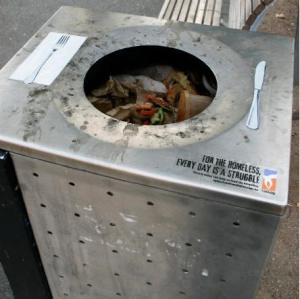
Aside from the people who do not know what a trash can is, the audience for this image is everybody. At some point or another we have all thrown away perfectly good food. This image of a trash can with a fork, knife and napkin on it makes the trash look like it is meant to be a plate of food. At first, this image can be very confusing: a trash can is no place for forks and knives, and trash is not for eating. The image instantly utilizes pathos when it dawns on the viewer that this image represents a very sad reality for the homeless population. This image successfully evokes a feeling of pity and guilt in the viewer. It is very hard to look at this image without thinking of a time when you wasted food because you weren’t hungry anymore or it wasn’t “good”.
The color in this image plays an important role in evoking pathos. Almost everything in the picture is gray, and the only thing that is not gray is the trash, which is an especially disgusting color. The grayness of the image makes the entire situation feel bleak and depressing. The image would not have the same effect if the trash was brighter and the trash can was a color such as yellow.
The dirt on the outside of the trash can emphasizes how unfortunate the homeless are. In such desperate times, beggars cannot be choosers: the food they find will not be clean and could even be extremely unhealthy to eat. Something to think about while looking at this image is that someone who is not homeless can look at this picture (or a trash can) and the things that stand out the most are the how unsanitary it is, while someone who is homeless will most likely look at a trash can and only see food.
Overall this image is very effective at highlighting a problem in an unconventional way.
 Views All Time
 Views Today