Response to Prof. Vee – Tailoring Tactics of the Transgender Law Center
The Transgender Law Center is the state of California’s is first transgender legal organization. It is a non-profit organization dedicated to changing the attitude of the public, as well as law and policy, to aid people in the quest to live free from discrimination or fear regardless of their gender identity.
The center’s Facebook page provides a more dynamic yet complete overview of the center’s mission. Any Facebook user can access this page and post to its wall or reference it in a post. Facebook is a public forum, so though the page is run by the official staff of the TLC, the information on the page may not be entirely their own; it can be manipulated. Therefore, information on the Facebook page may be tailored differently than what is available on the official website. In order to observe a difference in the tactics used to spread information to the audience, both websites must be compared, though further analysis will be centered only based on the Center’s Facebook profile.
A combination of ethos and pathos tactics are used to target the site’s (and the center’s) audience – in this case anyone concerned with the rights and treatment of people who identify as transgender. Some facts and statistics can be found through scouring the page, which also brings the logos appeal into the overall picture. The information posted by the TLC is well-rounded in that multiple tactics are used and the site includes photos, personal testaments, statistics, and many resources that link to more information. That being said, there is no question that the information provided by the TLC is biased. One will find only information that will allow the Center to further their cause. The goal of the site is not to educate the audience about both sides of the issue, but rather to encourage the reader to take the side of the TLC.
The two most interesting aspects of this page (interesting for the tactical audience less interested in the issue than the methods used to convey it) are the posts or “reviews” made by the public – people who are not TLC staff – and the links that are posted to the page’s timeline.
Links connect the audience to more information sponsored or created by the TLC. One can easily find the link to the official website, the center’s twitter account, and a place to donate to the cause when navigating the Facebook profile. This is a common feature amongst websites that serve to advocate a cause. Less common are the links to alternate sources (not sponsored or part of the Center) that are present on the page. Many of these are news articles. They depict two common themes; either promoting an organization, person, or school that agrees with the Center’s objectives (“all people can live safely, authentically, and free from discrimination regardless of their gender identity or expression.”) or alternately, calling attention to a person, organization, etc, who has done the opposite and opposes the message the Center operates to promote. These links give the Facebook page credibility. It proves that this organization is not an independent cause; it proves that other organizations share similar goals and opinions and are also working to improve a situation that the Transgender Law Center views as problematic. Many of the stories shared are of victories related to the center’s cause or intend to be relatable to the audience. For example, this story about a World War II Veteran who identifies as Transgender creates an emotional appeal; the primary audience is American and thus are expected to respect a veteran, creating a reason to read the story and maybe align their views slightly differently afterwards. The links that expose stories that oppose the philosophy of the Center (directly or otherwise) prove to the audience that there is an issue, and often brings an emotional appeal. Knowing that there is some form of argument or discussion over the issues that the TLC is concerned with also brings credibility, it shows why the organization cares about these problems.
As stated previously, Facebook is a public forum and thus anyone can contribute to the page. Facebook users can leave ‘reviews’ on the Timeline of the TLC’s page. These reviews can then be viewed by anyone else who visits the page. Most of the reviews leave positive messages or encouragement and agreement for the Transgender Law Center. As with any debated issue, however, some people clearly disagree with what the organization is attempting to promote. The reviews are written by the audience that has chosen to participate in the Center’s Facebook page. Most contributions are positive.
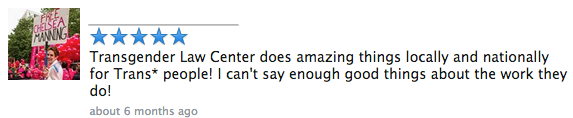
However, some are not.
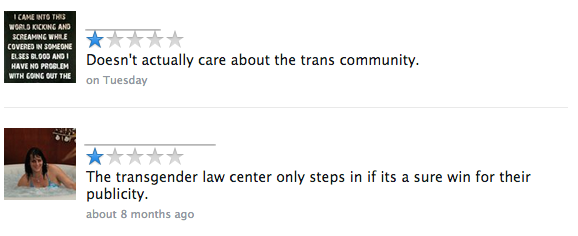
Regardless of whether these people are right or wrong, their contribution to the Facebook page makes the issue more interactive; it brings the problems closer to the people. Posting to the page may not bring about any change regarding the treatment of Transgendered people, but by contributing the audience creates their own voice in the issue, a sort of emotional appeal that is relatable for other people who then read their reviews or are encouraged to write their own.
The tactics that the Transgender Law Center uses to promote their cause – equality and justice for those who identify as transgender – are the same tactics that any public cause uses to communicate their issue. The Center’s Facebook profile is a condensed version of their official website. It reinforces the cause of the TLC by publishing stories and photos that try to convince the reader that what the Center advocates is something correct, worthwhile, and something that the reader should agree with. The information is skewed to aid with furthering the Center’s beliefs, but the information provided is factual despite not providing a well-rounded perspective on the issue. It is up to the reader to decide whether to align with the Transgender Law Center, or seek alternative opinions.
All images were obtained through the Transgender Law Center’s Facebook page.
 Views All Time
 Views Today
On the Facebook page I think it is interesting to look at how the tabs are organized and how the information in the “About” section is organized.
When you open the page the timeline is first followed by the “Get updates”, “Twitter” and “More” tabs. I find it extremely interesting that they have chosen to make the Twitter tab more visible than the Donate tab. A Facebook user is already seeing the social media information from the company so you might think that displaying the Twitter page is slightly redundant.
As someone who is a member of a non-profit group, donations are extremely important to the success of the organization; making that tab less visible might cause users to miss the donate option entirely.
As you discussed, the “Reviews” section gives readers a less bias view of the company. This tab is also hidden in the “More” section which could cause readers to overlook that information and miss out on potentially more accurate information.
The “Get Updates” tab is extremely user friendly which would encourage any interested party to sign up quickly. The “About” section is ordered extremely logically starting with the companies mission, proceeds to the company’s overview which is hidden for readers who are more interested in seeing the overall information and have the option to pursue more in-depth information.
Finally there is a brief section directing a reader with specific legal issues to contact a specific person.
Overall the logical flow makes the page easy to navigate and easy to find the information a Facebook user might be interested in.