
Sugar Rush: Challenging Everything You Know About Nutrition
Currently in America 34 percent of adults suffer from metabolic syndrome, a condition that consists of the combination of two or more of the following: high blood pressure, obesity, type II diabetes, heart disease, and high cholesterol. This syndrome puts individuals at high risk for heart attack and other cardiovascular disease. Some research suggests that fructose sugar is responsible for the metabolic syndrome epidemic.
After reading the book Year of No Sugar: A Memoir by Eve Schaub I became extremely interested in learning more about the effects of sugar on the body. The book follows the life of a family that decided to cut all fructose from their diet for a year. (Learn more about Schaub’s project on her blog)
In the book, Schaub refers to the YouTube video “Sugar: The Bitter Truth” presented by the University of California’s Dr. Robert Lustig. Dr. Lustig’s goal is to convince his audience that sugar, more specifically fructose, is a poison that is causing many of the health problems facing Americans today.
The video is set in a lecture hall and follows Lustig’s argument using simple blue and yellow visual slides. His immediate audience is the class; however, because the video is on YouTube, his audience includes anyone who might be interested in learning about his research no matter their level of education.
I believe the doctor is successful in communicating with both his immediate audience and larger online audience because he explains scenarios using metaphors and tells the audience what information is crucial to their understanding. He is very aware that his audience may not have a background in biochemistry and explains the concepts accordingly. He even uses humor to make the audience at ease with an intimidating scientific concept. In the video (44:35) he explains the biochemistry of the breakdown of different sugars, glucose, fructose, and ethanol in the body. He poses each sugar as a familiar food: white bread, orange juice and a shot of liquor respectively. Despite the high-level concepts behind these processes, Lustig explains in the simplest terms how each step happens; what each step produces; and how that product affects the body. To improve the clarity of his argument, flow charts are also used to help the audience follow his logic. The reasoning and flow of logic successfully informs the audience why Lustig’s argument is valid.

This chart displays the 8 of 15 conditions fructose consumption shares with chronic alcohol exposure.
The rhetorical appeals that are used are logos, ethos, and pathos. Lustig uses reasoning and logic to explain how he concludes that fructose is poison. He shows how fructose is broken down in the body and the resulting illnesses. (1:02:00) Additionally, he draws comparisons to the effects of long-term alcoholism to the effects of long term fructose consumption. One of the facts he uses to compel the audience to believe that alcohol and fructose affect the body the same way is: eight of the fifteen conditions caused by chronic alcoholism arise from fructose consumption too. Additionally, he explains why the current belief that fat causes health problems is incorrect. Explaining why the current beliefs are incorrect, and how the fructose argument is correct helps his credibility and makes his argument sound.
Lustig also conveys ethics and credibility because he is a doctor in the Endocrinology and Metabolism Department at the University of California. His profession suggests he is ethical and is in a field that works to improve the quality of life of citizens. He cites other research in his presentation that supports his argument as well. One of his sources, the book “Pure White and Deadly written in 1972, gives the same argument that sugar is one of the main causes of cardiovascular disease.
The pathos appeal comes from the fact that humans are constantly looking for ways to avoid illness and remain healthy. After logically explaining his argument, it seems the audience is generally concerned that they are poisoning their body every day with the food they eat. This concern may result in the audience taking action. I personally was shocked and compelled to consider all the ways I consume fructose as well as ways I could decrease my fructose consumption.
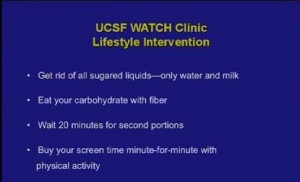
The lifestyle changes Dr. Lustig suggests for a diet that will avoid fructose consumption.
In the final part of the video (1:10:36) he tells the audience what actions they can take to improve their health. He states four rules that he recommends his patients follow to help eliminate fructose from their diet and decrease the metabolic syndrome conditions.
Ultimately, this video is compelling and with 5,005,731 views, his message is reaching a significantly larger audience than just those individuals in the lecture hall. With so many adults at risk for obesity, diabetes, and cardiovascular disease, it is important to consider all the potential reasons these illnesses continue to plague the American people.
Sources:
http://eveschaub.com/category/a-year-of-no-sugar/
http://www.heart.org/HEARTORG/Conditions/More/MetabolicSyndrome/About-Metabolic-Syndrome_UCM_301920_Article.jsp
 Views All Time
 Views Today
Recent Comments