
Rhetorical Velocity in Tweets
When promoting an idea, company, or organization, rhetorical velocity is a necessary tool that will help circulate what you are trying to say. So when I was looking for examples of this, I skimmed through the twitter profiles of the 5 accounts I followed, and chose the ones that caught my eye the most, because that’s what rhetorical velocity does right? It has that X factor that makes people want to circulate and talk about it.
The first example of rhetorical velocity I saw was on a post by ‘Don’t Trash My Turf’
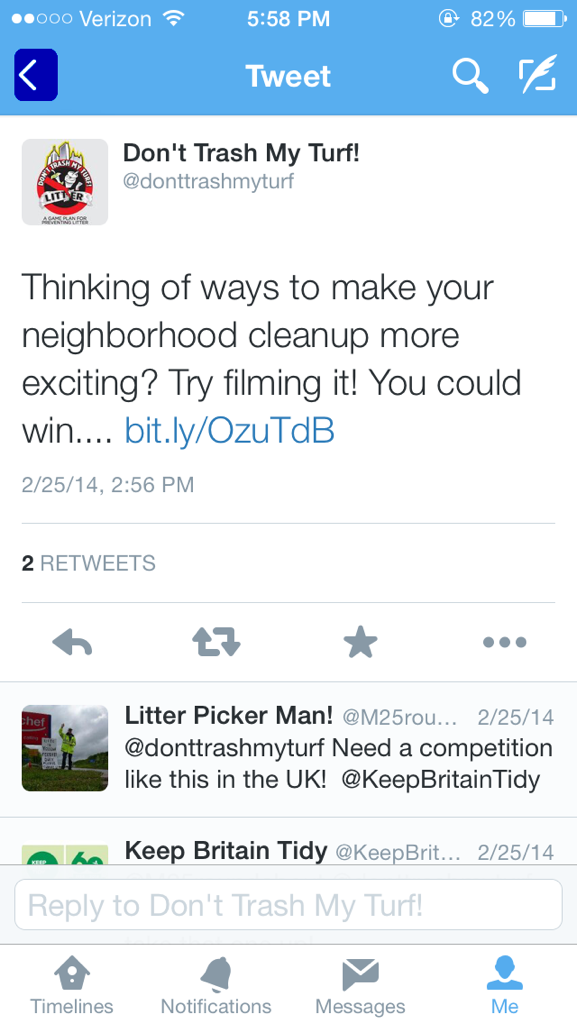
They are promoting a video contest where applicants can win money, while also creating a way to make cleaning litter more fun. As you can see, this tweet was retweeted twice, and someone “commented” saying that they would like a similar contest in the UK. Already, this post shows that rhetorical velocity is present, based on the fact that people have interacted with the tweet.
The second example of a tweet with rhetorical velocity can be seen here

This is another interesting tweet, because it talks about a Pittsburgh company (Allegheny Mountain Hardwood Flooring) which applies to Greener Pittsburgh. The hardwood flooring company provides customers with certified eco-friendly lumber and is a Green Biz listing. Rhetorical velocity is present in this tweet because of it’s uniqueness. Often times, eco-friendly twitter profiles such as Greener Pittsburgh only tweet about things that apply to them. Instead, a Pittsburgh business is being promoted, while also incorporating the fact that it’s product is beneficial to the environment. They also used the hashtag “green” and “hardwood” to promote circulation of this topic.
For my own tweets, I decided to use rhetorical velocity in a different way. For my first tweet, I decided to post a picture of a specific instance where litter was present in South Oakland. This is relevant to my followers because most of them are Pitt students and have seen the situation in Oakland. Under the picture, I used pathos to establish my rhetorical velocity, because I showed disgust when I said “Pitt students can’t stand by and watch this happen”. Hopefully, this invoked emotion into anyone else reading my tweet. My second tweet provided a link to PMADD, which is a program where students can get involved in the fight against litter. Hopefully, this inspired the drive to get involved and the desire to recirculate information about it. My third and fourth tweets provided links, pictures, and information about the Great Pacific Garbage Patch. This doesn’t necessarily have to deal with litter in Pittsburgh, but with one of the most severe outcomes of littering in human history. The goal of these tweets were to provide rhetorical velocity through pathos and ethos, because it shows how littering in general is ruining our environment. Finally, my fifth tweet provides the reader with a news story about how a Steeler’s wide receiver was dropped from an anti-littering organization for littering. I believe Rhetorical Velocity is present here because of how it applies to Pittsburgh students and residents (being in the area) and because of the interesting irony in it. The fact that this happened is reason enough to circulate the article/tweet promote anti-littering even more.
 Views All Time
 Views Today
I chose your tweet where you posted the picture of litter in South Oakland as my favorite one of your tweets. I think it is a great way to appeal to your followers who are mostly Pitt students. It does a great job of showing that the littering problem in Pittsburgh isn’t just something in the news and online, but that it is really happening on our very own streets. I see very similar scenes on the street of South Oakland myself, and think that this picture is a great way to generate some attention for the litter in Oakland as well as providing some great rhetorical velocity. I think that if you included some type of hashtag in that tweet relating to litter on the Pitt campus that it would have done a great job of taking the tweets already excellent rhetorical velocity to the next level.