
Tweeting About Water Conservation
Reviewing a water conservation tweet’s rhetorical velocity was particularly interesting because many of the tweets are not successful in gaining attention from the Twitter audience. I looked at tweets from the Surfrider Foundation and found that tweets pertaining to topic were not always as popular as those that were visually attractive. The Surfrider Twitter page has 104,000 followers 13,300 tweets.
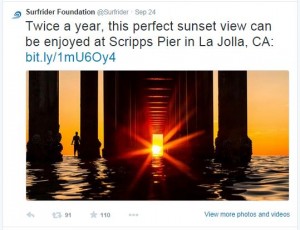
https://twitter.com/Surfrider/status/514938651843641344
The tweet seen on the left is one of the more popular tweets on the page, yet it offers little to no information about the conservation efforts this group makes. It received 91 re-tweets and 110 favorites which is significantly less than 1% of their followers. This tweet received attention because of the beautiful image.
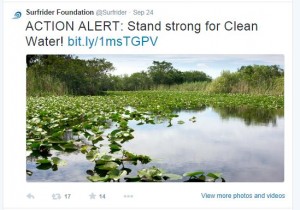
https://twitter.com/Surfrider/status/514885523135946752
The tweet seen on the right is one that calls followers to take up action and become involved. Clicking the link which takes you to a page that asks for input on a clean water bill revision. This tweet has value to their organization and needs the audience to respond, yet the tweet received only 17 re-tweets and 14 favorites.
While most water conservation twitter accounts had minimal rhetorical velocity, tweets with relevant hashtags, striking images, and a catchy statement had more audience interaction than those without. The use of hashtags is important because it connects information with the same topic. It narrows the audience to Twitter users that are interested in the keyword that is hashtagged. My followers might re-tweet the post which would introduce the topic to an entirely different audience.
I have applied hashtags, images, and short effective statements to the following tweets:
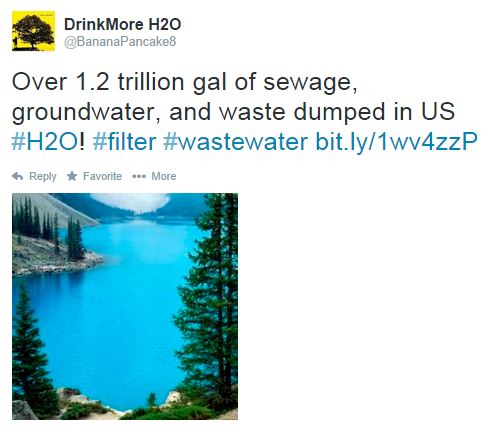
In this tweet, I led with a shocking fact that was found in the article. I used the hashtags to bring attention to wastewater and to reach an audience that might be interested in water and water reclamation.
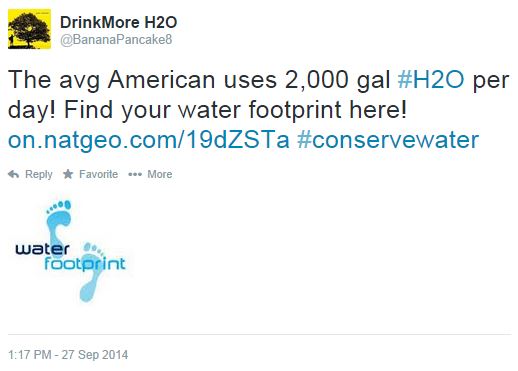
I chose to incorporate some interactive elements in this tweet. Involving the audience may make them more likely to re-tweet or share the information. It also includes an interesting fact that would grab an audience’s attention.
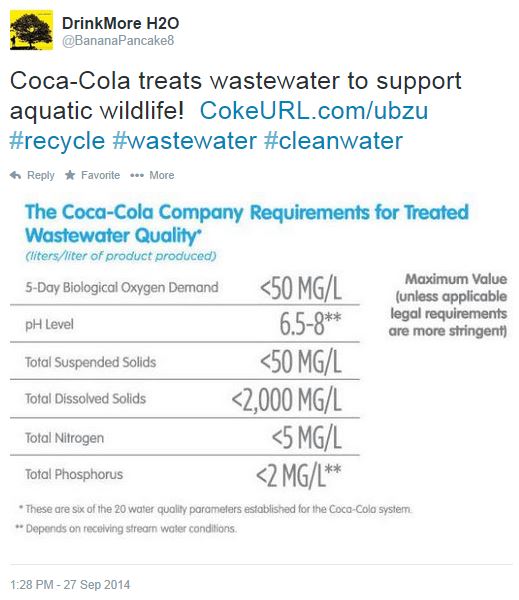
The image in this tweet gives a quick rundown of how Coca-Cola is regulating its wastewater so the audience doesn’t need to follow the link unless they are interested in more information.
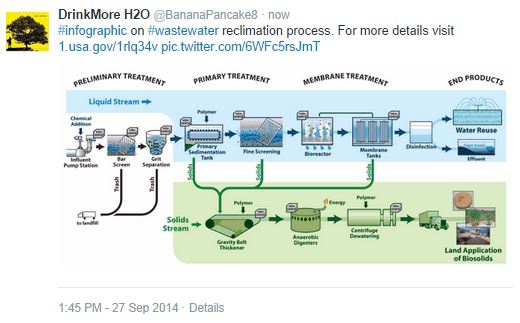
This tweet’s advantage is that the infographic is simple and straightforward. Again, the audience can get more detailed information or just share the image.

I chose not to include an image in this tweet because it contains a video. I tagged the organization that produced the video so the audience could get additional information from their Twitter account.
UPDATE: After checking up on my twitter account I confirmed the techniques I used were effective! Tagging the WateReuse Association in the above tweet led to some retweets by their organization which expanded my audience significantly. Also, The Alberta Water & Wastewater Operators Association, a Canadian organization, retweeted the above tweet. I never would have expected someone in a different country would retweet my information. This shows that Twitter is an extremely effective tool to create rhetorical velocity.
All tweets and related links can be found on my Twitter page.
Featured photo can be found here.
 Views All Time
 Views Today
I retweeted your tweet about how 1.2 trillion gallons is dumped in the U.S. annually. As you said in your blog post, I found this to be shocking and it made me interested in learning more about the issue of water conservation, which I was able to do because you included a link to more information. I think the use of hashtags will be good for this tweet’s rhetorical velocity because many people who are interested in water issues will see your tweet, allowing them to retweet it. Overall, I think your tweet did a good job of reaching a large audience, getting them interesting in the issue, and then giving them access to more information. It might also lead them to spread the issue to people they know through retweeting.
I thought your best post was your tweet with the video about the urban water cycle! It probably stuck with me the most because of the video, i just naturally clicked on that first, and after viewing all your tweets, the video was still the tweet that had the biggest impact on me. To help you raise awareness on your topic i choose to favorite and retweet the video!
I retweeted the tweet about the 1.2 trillion gallons of sewage groundwater and waste dumped into US water. You started with shocking fact that made me want to click on the link to read more. The use of hash tags also helped draw attention to your tweet. The fact that I ended up clicking on the article to read more is a testament to how effective the tweet was.