The Immorality of Football
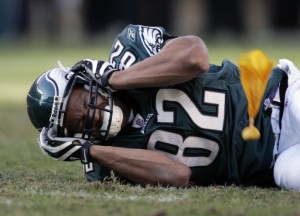 In the article “Quitting Football,” Ian Crouch tailors his writing to diehard football fans. He beginning the article with last night’s NFL game that forced Seattle Seahawk Lacy out of the game due to a concussion. Crouch uses exigence by opening the article with a recent incident of a concussion which he uses as a platform to build on the issue of sports related concussions and football. In the article, he interviews Steve Almond, a former diehard NFL fan and author of the book “Against Football,” who speaks of the physical dangers along with issues like “violence, greed, racism, and homophobia” that football brings to American society. Almond builds his argument to the point where he says “it is never O.K. to watch the Patriots.”
Throughout the interview, Almond’s ethos are compromised because he fails to establish his character and credibility. While Almond claims to have been a fan of the NFL for over forty years, he appears to be an angry skeptic who immediately criticizes the game of football without any credibility. However, the author convinces us that Almond is a true fan by referring to his quote about football awakening “within us deep recesses of emotion, occasions for reflection, reasons to believe.”
The article appeals to the audience’s pathos very often. Almond’s strong word choice when referring to football as a “violent, savage, beautiful spectacle” addresses the emotion of the audience. Almond challenges the values of the audience by saying that it is “immoral to watch a sport that causes brain damage.” He also invokes the audience’s sympathy by speaking of his mother who suffered a serious brain injury.
Almond attempts to use logos by arguing that his premises lead to the conclusion that no one should watch football. However, the audience must first accept that football fosters “violence, greed, racism and homophobia,” and that it’s the fans responsibility to stop watching football in order for professionals to stop playing it. Because these premises are not fully valid, it is hard for the audience to accept Almond’s conclusion to stop watching football.
If Almond’s argument grasped any reader’s attention, his entire credibility erupts at the end of the article. When the interviewer asked about Almond’s favorite team- the Raider’s losing season, Almond replies “If the Raiders were really good, I might not have written the book.”
http://www.newyorker.com/news/sporting-scene/quitting-football
 Views All Time
 Views Today
This is an interesting point of view. In a way I can understand where he is coming from. Football is a very violent sport. Not only that, but as time goes on the players seem to be getting bigger and bigger. It’s only in the past ten years that we’ve really come to acknowledge how dangerous concussions are. He has a decent argument, but I think his ethos and logos are what compromises him. America is obsessed with football. If you are trying to convince fans to stop watching, I don’t think calling football violent, greedy, racist, and homophobic are the right way to go about it. His claim is that football is dangerous and causes fatal head injuries. He should stick to this argument and provide more statistical data. Insulting the sport right off the bat causes the reader to put up a wall, making him or her less likely to be open to the more valid aspects of Almond’s argument.
I definitely agree with you, his argument that football is causing dangerous injuries and something should be done about it is valid and convincing for the audience. However, jumping to the conclusion that watching football is wrong because of the injuries involved is far-fetched.
I agree that his argument is has no credibility. I was willing to ignore his argument that football “fosters within us a tolerance for violence, greed, racism, and homophobia” but he completely lost me when he stated that “it is immoral to watch a sport that causes brain damage”. By this logic it is immoral to watch just about anything. Am I behaving immorally when I watch someone drive their car, knowing full well that it is an activity that could potentially cause brain damage? No. Ian Crouch’s argument has no credibility as he does not back up any of his preposterous statements and his appeals to reason could be valid if, and only if, anyone else agreed with his skewed perception of what reason is. In the end, he is trying to make an argument where there is no argument to be made.
This article presents a strange situation where the author is addressing fans of football, but is presenting an argument against the sport. There are points in the article at which the author seems to be presenting conflicting viewpoints. He claims that football is overly violent and filled with greed, racism, and homophobia. However, he also explains how beautiful the game is.
While it is true that football is a violent sport, I believe it has always been that way. In recent years, NFL officials have attempted to make the game safer by limiting the amount of time that players can play full contact in the preseason and offseason. This has possibly lead to a decrease in the physicality of the modern football player. Also, with new safety rules comes a closer examination of players. This causes for players to miss more time as a result of injury.
The NFL recently acknowledged how physical the game has been through a settlement with former players.
http://www.nfl.com/news/story/0ap2000000363672/article/federal-judge-approves-nfl-concussion-settlement